Most people searching for help with acid reflux have already seen the list. Avoid coffee, tomatoes, chocolate, citrus, mint, spicy food, alcohol and anything else that made eating enjoyable. Some of those lists run to six pages.
Here’s what acid reflux, GERD and heartburn mean, what the evidence says about common triggers and which changes are most likely to help you, rather than the average person in a clinical trial.
Each section has a short summary if you’re in a hurry.
What is acid reflux?
Acid reflux is what happens when stomach contents move back up into the oesophagus, the tube that connects your mouth to your stomach. That upward movement is called reflux.
Your stomach and oesophagus are separated by a ring of muscle called the lower oesophageal sphincter (LOS). Normally, this muscle closes after food passes through it. When it relaxes at the wrong time, or doesn’t close fully, stomach contents escape upwards. What you feel, if you feel anything, depends on how often this happens, how far up the contents travel and how sensitive your oesophagus is.

Heartburn
Heartburn is the most recognisable symptom of acid reflux. It’s a burning feeling in the chest or throat, usually after eating or when lying down. Despite the name, it has nothing to do with your heart.
GERD
GERD (gastro-oesophageal reflux disease) is the medical diagnosis given when reflux is frequent, troublesome or causing damage. An occasional episode after a large meal is common and doesn’t automatically mean you have GERD. The diagnosis typically applies when symptoms are happening multiple times a week or causing complications like oesophagitis.
Acid reflux vs GERD vs heartburn: what’s the difference?
These terms are often used interchangeably, but they’re not the same. Acid reflux describes the mechanical event. Heartburn is a symptom that reflux can cause. GERD is a diagnosed condition. You can have acid reflux without feeling heartburn. You can have heartburn without meeting the criteria for GERD.
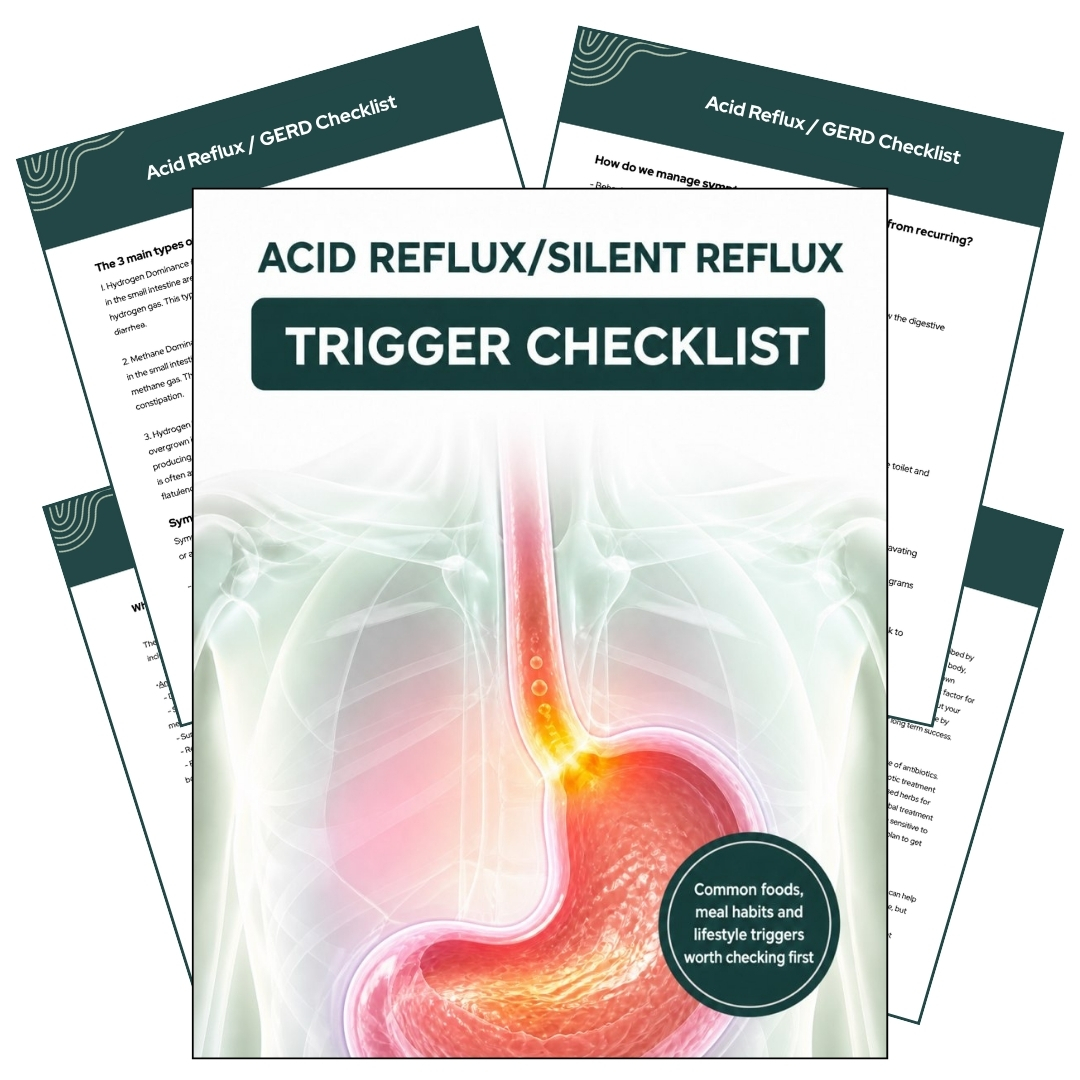
Get the free Acid Reflux/Silent Reflux Trigger Checklist
A one-page checklist of the foods, meal habits and situations most worth reviewing first.
Common symptoms of acid reflux and GERD
The classic symptom is heartburn: a burning sensation in the chest or throat. But reflux can cause a wider range of symptoms:
- Regurgitation (a sour or bitter taste coming back into the mouth)
- Burping
- Bloating or fullness after meals
- Nausea
- A feeling that food is stuck in the oesophagus
- Chronic cough, particularly at night
- Hoarseness or a persistent sore throat
Some people have several of these. Some have only one. A small number of people with confirmed GERD on testing have no symptoms at all. This is called silent GERD. Chest pain is also associated with GERD, but chest pain always needs proper medical assessment to rule out cardiac causes first.
Are reflux triggers the same for everyone?
No. This is where a lot of standard reflux advice falls down.
The familiar trigger list includes coffee, alcohol, chocolate, mint, spicy food, tomatoes, citrus and high-fat meals. It comes from studies looking at population averages. Those foods are worth reviewing. Whether any of them affects your reflux depends on your anatomy, how sensitive your oesophagus is and the context of your meal.
Some foods promote reflux by relaxing the lower oesophageal sphincter (fat, chocolate, mint, alcohol and caffeine all do this to varying degrees). Others irritate an already-inflamed oesophagus without causing the reflux itself. Acidic foods like tomato and citrus often work this way. And some foods on the standard list cause no symptoms for you at all.
A smarter approach than blanket elimination:
- Look for patterns across multiple meals, not single incidents
- Test one change at a time, so you know what made the difference
- Keep foods that don’t appear to cause you problems
- Pay attention to portion size and timing as well as what you ate
Get the free Acid Reflux/Silent Reflux Trigger Checklist
A one-page checklist of the foods, meal habits and situations most worth reviewing first.
What actually helps with acid reflux
This is the section most articles skip past. Here’s what the research actually supports.
Losing weight (if it’s relevant)
Weight loss has the strongest evidence of any lifestyle change for GERD. Excess weight, particularly around the abdomen, increases pressure on the stomach, which pushes contents upward. A large study following over 29,000 women found that even modest weight gain was associated with increased reflux symptoms, while weight loss reduced them significantly. This doesn’t mean everyone with reflux is overweight, but if it’s relevant to your situation, addressing it tends to have a bigger impact than removing any single food.
Stopping smoking
Smoking weakens the lower oesophageal sphincter and reduces saliva production. Saliva helps neutralise acid in the oesophagus, so less of it means symptoms persist longer. If you smoke and have reflux, this is a strong reason to stop.
Smaller meals
Large meals stretch the stomach and increase pressure on the sphincter. Eating smaller amounts more often is one of the most practical, low-risk changes to trial, especially if fullness or pressure after eating is part of your pattern.
Not lying down soon after eating
Gravity helps keep stomach contents where they belong. Lying down within two hours of eating removes that advantage. For night-time symptoms, leaving at least two to three hours between your last meal and bed can make a real difference.
Elevating the head of the bed
For persistent night-time reflux, raising the head end of the bed by around 15–20 cm (6–8 inches) is supported by evidence. Extra pillows don’t achieve the same effect. They flex the body at the waist and can actually increase pressure on the stomach. Bed risers placed under the legs or a wedge under the mattress work better.
Reducing alcohol
Alcohol relaxes the lower oesophageal sphincter and can increase acid production. It’s one of the more consistently identified triggers across the research. That doesn’t mean everyone with reflux needs to stop drinking entirely, but it’s a sensible variable to test if you drink regularly.
Diaphragmatic breathing
This one sounds unusual but has reasonable evidence behind it. Diaphragmatic breathing strengthens the diaphragm, which plays a role in keeping the lower oesophageal sphincter closed. Research suggests it can reduce reflux episodes and improve symptoms in people with GERD. It’s not a substitute for medical treatment in someone with erosive oesophagitis or Barrett’s oesophagus, but for persistent reflux that hasn’t fully responded to standard changes, it’s worth exploring with a physiotherapist.
Identifying your personal food triggers
Rather than following a universal restriction list, the useful goal is working out which foods, in which amounts and contexts, reliably affect your symptoms. A food and symptom diary kept for two to four weeks can help clarify what’s actually worth testing. The most common food triggers to investigate first: high-fat meals, chocolate, mint, coffee, alcohol, carbonated drinks, spicy food, citrus and tomato-based sauces.
Medication
For many people with GERD, lifestyle changes alone don’t fully control symptoms, and that’s normal. H2 blockers (such as famotidine) reduce acid production and work well for mild to moderate symptoms. Proton pump inhibitors (PPIs) such as omeprazole are more potent and are often the first-choice medical treatment for confirmed GERD. Don’t stop prescribed medication because of a checklist. If your treatment isn’t helping or you’re concerned about long-term use, review it with your doctor.
Why symptoms can continue even when you’re doing the right things
If you’ve made the standard changes and still have symptoms, there are a few possibilities worth understanding.
Not all persistent oesophageal symptoms are caused by acid. Reflux hypersensitivity, functional heartburn and rumination syndrome can all produce heartburn-like symptoms with normal acid levels on testing. These are real conditions. They need different assessment and, often, different treatment.
Some people with functional heartburn respond to approaches like cognitive behavioural therapy, gut-directed hypnotherapy or diaphragmatic breathing. If symptoms continue despite a genuine trial of lifestyle changes and appropriate medication, the next step is to review the diagnosis with your doctor. An upper endoscopy, pH monitoring or oesophageal manometry can help clarify what’s actually going on.
When to get medical advice
See a doctor if:
- Symptoms are happening more than twice a week
- You’re using over-the-counter medication regularly
- You have difficulty or pain swallowing
- You’re losing weight without trying
- There’s blood in vomit, or your stools are black or tarry
- Symptoms are changing or getting worse
- You have chest pain, which needs urgent assessment to rule out cardiac causes
One practical checklist. No seven-day diary and no universal food blacklist.
Sources and further reading
- American College of Gastroenterology: Acid reflux and GERD
- NIDDK: Eating, diet and nutrition for GER and GERD
- AGA: Personalised evaluation and management of GERD
- Ness-Jensen E et al. (2016). Lifestyle changes and GERD. The American Journal of Gastroenterology
- Kessing BF et al. (2012). Diaphragmatic breathing reduces belching and reflux in GERD. The American Journal of Gastroenterology
This article is for education only and does not diagnose, treat or cure reflux. Persistent, severe or changing symptoms should be assessed by an appropriate healthcare professional.